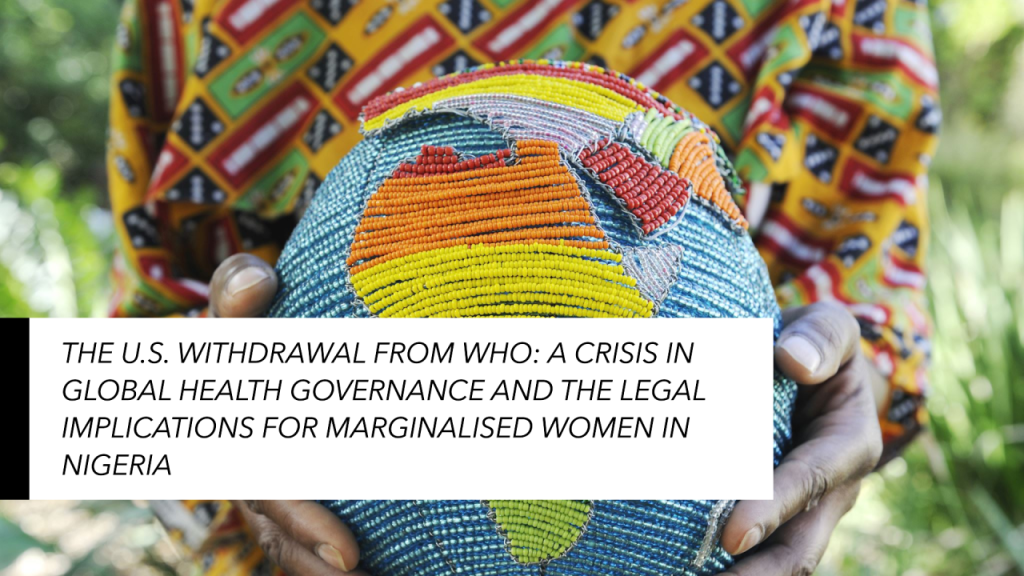
At Lex Initiative for Rights, Advocacy and Development (LIRAD), we are deeply concerned about the ripple effects of President Donald Trump’s decision to withdraw the United States from the World Health Organization (WHO). While the immediate consequences of this withdrawal on global health systems have dominated headlines, less attention has been given to the legal and policy implications, especially for marginalised women in countries like Nigeria.
Our work at the Lex Initiative focuses on advocating for systemic legal and policy reforms that address the barriers faced by marginalised women with intersecting vulnerabilities. While we do not provide direct services, we engage in policy advocacy, legal analysis, and capacity-building to strengthen the frameworks that protect and empower these communities. The U.S. withdrawal from the WHO threatens to weaken global health governance, creating policy vacuums and undermining the very systems designed to safeguard vulnerable populations.
Global Health Governance at Risk
The WHO serves as a cornerstone of global health governance, setting international health standards and driving initiatives to address health inequities. Its guidance influences national policies in areas such as maternal health, mental health, and gender-based violence (GBV). The U.S. withdrawal not only diminishes the financial resources available to the WHO but also undermines its authority and ability to lead coordinated global health efforts. For Nigeria, this weakening of governance poses several challenges:
- Diminished Advocacy for Gender-Sensitive Health Policies
The WHO has been a key advocate for integrating gender sensitivity into global health policies, influencing Nigeria’s commitments to issues such as sexual and reproductive health and rights (SRHR). The loss of U.S. funding risks slowing progress on these fronts, creating legal and policy gaps that disproportionately harm marginalised women. - Weakening of Legal Frameworks Addressing GBV
Nigeria’s efforts to address GBV—through policies like the Violence Against Persons Prohibition (VAPP) Act—have been informed by international standards promoted by the WHO. A weakened WHO reduces the global pressure and resources needed to sustain and expand these frameworks, leaving survivors of GBV with fewer protections. - Undermining of Mental Health Advocacy
The WHO has played a pivotal role in bringing mental health to the forefront of global health priorities. Nigeria’s legal and policy landscape for mental health is still developing, with gaps that disproportionately affect marginalised women. Without strong global leadership, mental health risks being deprioritised in national policy discussions. - Erosion of Accountability in Health Governance
The WHO holds countries accountable for meeting global health standards, including commitments to equitable healthcare. A diminished WHO weakens this accountability mechanism, making it easier for governments to sideline health and gender equity issues in their policymaking.
At Lex Initiative, we recognise that strong legal and policy frameworks are essential for protecting the rights and dignity of marginalised women. The U.S. withdrawal from the WHO reinforces the urgency of our work in the following ways:
- Advocating for Policy Continuity and Reform
We will continue to advocate for Nigeria to align its health and gender policies with international standards, regardless of shifts in global funding dynamics. This includes pushing for the full implementation of the VAPP Act, strengthening SRHR protections, and addressing gaps in mental health legislation. - Amplifying the Voices of Marginalised Women
Our advocacy efforts are grounded in the lived experiences of the women we serve. By amplifying their voices in national and regional policy discussions, we aim to ensure that their needs remain central to Nigeria’s health and legal agendas. - Engaging Regional and International Advocacy Platforms
The U.S. withdrawal underscores the importance of regional cooperation. We are committed to working with bodies such as ECOWAS and the African Union to sustain momentum on health and gender equity policies in Africa. - Building Coalitions for Policy Advocacy
Collaboration is key to driving systemic change. We aim to strengthen partnerships with other civil society organisations, policymakers, and international allies to advocate for sustainable and inclusive health and gender policies.
In light of these challenges, the following steps are crucial for safeguarding the rights and health of marginalised women in Nigeria:
- Push for Increased Domestic Funding for Healthcare
Nigeria must prioritise domestic investment in healthcare to reduce reliance on external funding. This includes allocating resources to SRHR, GBV prevention, and mental health services, with a focus on marginalised populations. - Advocate for Legal and Policy Reforms
Civil society organisations must intensify advocacy for the adoption and implementation of gender-sensitive laws and policies. For example, fully implementing the VAPP Act nationwide and addressing legal gaps in mental health protection will be critical in the absence of strong global leadership. - Engage in Regional Advocacy
Regional bodies like ECOWAS and the African Union must take on a greater role in health and gender advocacy. By working with these bodies, Nigerian stakeholders can ensure that global health priorities remain on the regional agenda. - Hold Policymakers Accountable
Civil society must strengthen its role in monitoring government commitments to health and gender equity. Advocacy campaigns that highlight the impact of underfunded healthcare systems can pressure policymakers to take action. - Promote Public Awareness and Participation
Advocacy efforts must include public awareness campaigns to mobilise support for health and gender policies. Engaging communities and amplifying the voices of marginalised women will help build a grassroots movement for change. - Foster International Partnerships
While the U.S. withdrawal weakens global health governance, other international actors, such as the European Union and private foundations, remain committed to gender equity and health. Nigeria must strengthen its engagement with these partners to ensure continued support. - Focus on Capacity Building
Civil society organisations must invest in capacity building for legal and policy advocacy, ensuring that they have the tools and resources needed to influence systemic change.
Conclusion: A Call for Resilience and Solidarity
The U.S. withdrawal from the WHO is a wake-up call for Nigeria and other low-income countries. It highlights the fragility of global health governance and the need for local actors to take greater ownership of health and gender equity.
At Lex Initiative, we are committed to ensuring that marginalised women are not forgotten in the face of these challenges. Through advocacy, coalition-building, and policy reform, we will continue to fight for a Nigeria where every woman’s health and rights are protected.
However, we cannot do it alone. We need the collective effort of governments, civil society, and international allies to build a resilient and inclusive system that withstands global uncertainties. Together, we can ensure that marginalised women in Nigeria are not left behind.
Let this moment inspire action, not despair. The time to advocate for justice, equality, and dignity is now.
Signed,
Augusta Yaakugh-Shahin
Executive Director, Lex Initiative for Rights Advocacy and Development (LIRAD)